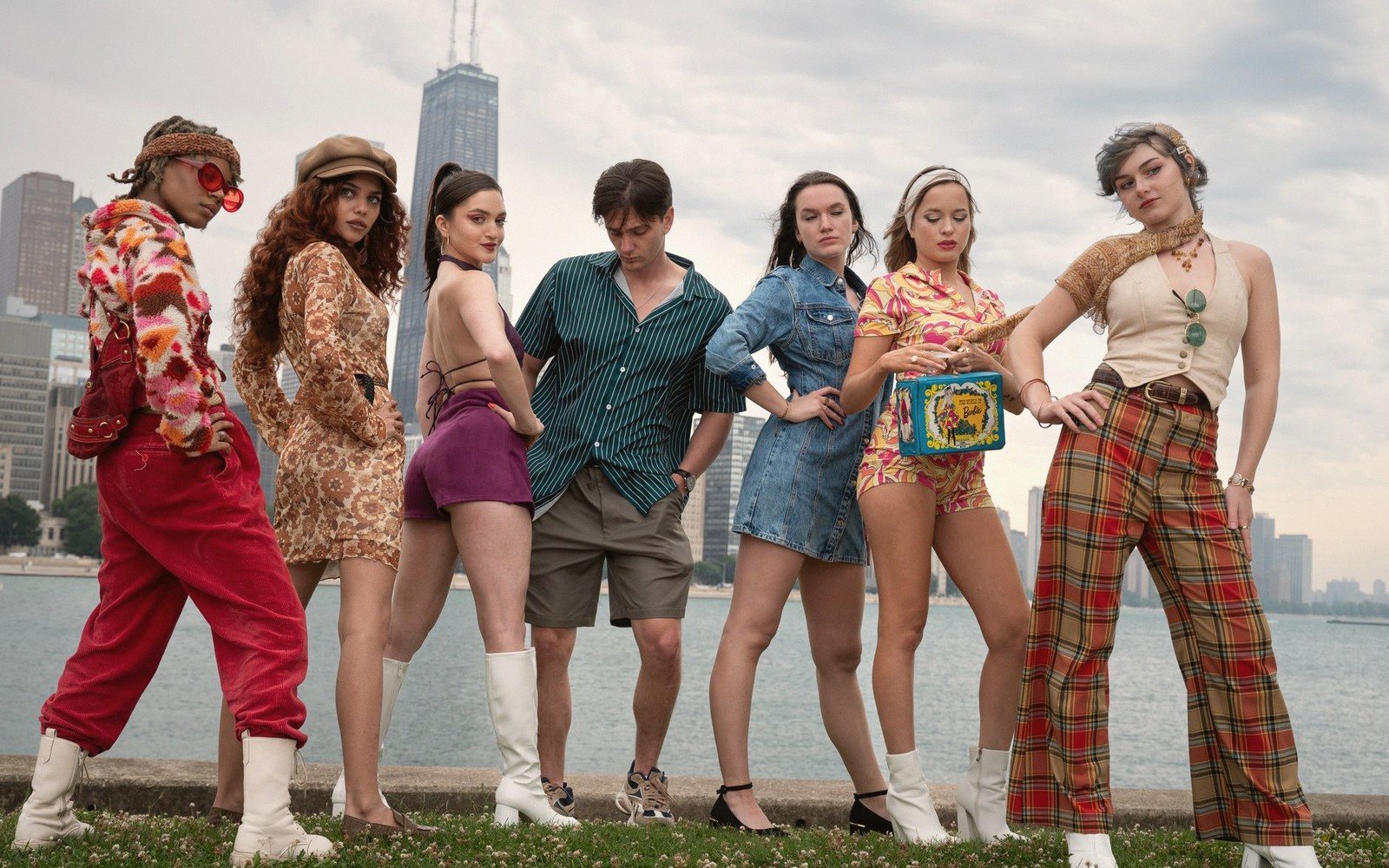
The Mood, Not the Museum
Every decade revival carries a risk: you end up looking like a theme party rather than a person. The seventies are especially treacherous in this regard, because the decade had such a strong visual identity — wide lapels, earth tones, platform heels, macramé — that the costume version is never far away. The trick, then, is to understand what you're borrowing and why, rather than raiding a prop closet wholesale.
What the seventies actually offer, stripped of the kitsch, is a particular attitude toward dressing: relaxed but considered, sensual but never fussy, and deeply committed to texture. The decade produced some of fashion's most enduring silhouettes — the fluid wide-leg trouser, the wrap dress, the blouson jacket, the peasant blouse — not because they were of their moment but because they were genuinely flattering across a range of bodies. That's the foundation. Build from there, and you have something real. Overcorrect toward groovy accessories and amber-tinted everything, and you have a Halloween costume.
The other thing worth noting is that this is not a clean, single-era revival. What's circulating now is a looser, more edited version of seventies dressing, filtered through decades of subsequent fashion — there's some early-nineties minimalism in how it's being styled, some current appetite for quiet luxury over the maximalist end of things. The silhouette is seventies; the restraint is very now.
The Pieces That Actually Work
Flares and wide-leg trousers. This is the non-negotiable entry point. The wide-leg trouser has never really left — it reappears with such regularity that calling it a trend at all feels slightly beside the point — but the current iteration leans into a proper flare that originates at or below the knee rather than the gentle wide-leg that's been cycling through for a while. The key to wearing it without tipping into costume territory is proportion. A true flare needs a balanced upper half: something fitted or tucked in, or a cropped jacket that sits at the natural waist. The drama is in the leg; the top half keeps it anchored.
Fabric matters here too. Denim flares read casual and direct. In a fluid crepe or a structured suiting fabric, the same silhouette moves upmarket without any extra effort. Avoid anything with obvious period detailing — contrasting stitching, exaggerated pockets, embroidery — unless you want the costume read, in which case, go ahead, but know what you're doing.
Suede. If there is one texture that encapsulates the seventies more than any other, it is suede. Soft, slightly napped, warm to the eye even in cool shades — suede carries a tactile quality that the decade understood instinctively. The revival here is in earnest: suede-effect fabrics have spread across everything from blazers to midi skirts to knee-high boots, and real suede has held its position as a considered investment material in outerwear and footwear. A suede or suede-effect midi skirt in camel, chocolate, or rust is one of the most useful pieces you can add to a wardrobe right now — it skews vintage in the best sense, it works with proportion you probably already own, and it will not date quickly because the silhouette is long-standing.
The styling note with suede is to let it lead. If the suede piece is the hero, the rest of the outfit earns its keep by stepping back: clean knitwear, simple footwear, minimal jewellery. Piling suede on suede is a risk that occasionally pays off for the confident, but most of the time it reads as effortful rather than easy.
The wrap dress. Diane von Furstenberg launched her jersey wrap dress in 1974, and the fact that you still know exactly what it looks like says everything you need to know about the endurance of the silhouette. The current iteration tends toward a slightly longer hemline — midi rather than mini — and favours prints that read painterly or graphic rather than the busy botanical patterns of the original era. Worn with a simple sandal or a low block heel and minimal jewellery, it is almost effortlessly right. Wrap dresses are also, practically, one of the most forgiving silhouettes that exists: adjustable, comfortable, and genuinely flattering across a wide range of proportions.
The blouson and the shirt-jacket. The overshirt-as-outerwear is a seventies staple that slots almost invisibly into current wardrobes because it has never fully gone away. A blouson jacket in suede, leather, or a technical fabric hits the era without any period signalling. Worn open over a simple roll-neck or close-fitted T-shirt, with wide-leg trousers and a low boot, it assembles into something that looks current without trying.
Platform heels and low block heels. Footwear is where a lot of revival attempts go wrong — a full platform in a bold colour is a strong statement that requires an equally strong commitment to the look. The safer entry point is the low block heel, a chunky-soled sandal, or the crepe-soled boot, all of which carry seventies DNA without the costume overtones. If you are drawn to a platform, keep everything else extremely simple: the shoe does the talking.
Wear the idea of the seventies — not the costume.
The Colour Story
Earth tones are the visual shorthand of seventies dressing — burnt orange, rust, ochre, warm brown, olive, cream — and they remain an easy route into the aesthetic because they are genuinely harmonious together. The revival is leaning into these tones with some force, partly because they work well with suede and wide-leg silhouettes, and partly because the current mood is warm-toned in general. Butter yellow and camel are doing particular work right now.
That said, the decade also produced some strong graphic dressing — high contrast, bold print, wide stripes in confident colours — and this is the more interesting and less obvious territory for anyone who finds the earth-tone palette limiting. A wide-stripe shirt in rust and cream, an abstract-print wrap dress, a textural knit in a saturated plum: these are all genuinely seventies in sensibility without being beige about it.
The mistake to avoid is mixing all of these at once. The seventies were not shy — the era layered print on print and texture on texture with some abandon — but for a contemporary reading, you want one or two elements at most. Earth tones as a palette, or a bold print as a focal point. Not both simultaneously, not unless you are very sure of yourself.
What to Leave in the Archive
Some things should stay there. The macramé vest. The patchwork denim jacket with twenty things happening on it simultaneously. Anything with a peace symbol as a decorative feature. The full-length suede coat with fringing — a single fringe element can work, but fringe-on-fringe-on-fringe is a commitment to cosplay that very few outfits survive. And the wide-collared shirt, unbuttoned to the sternum with visible chest: this is historically accurate and entirely unwearable for most people in most contexts.
The pattern to notice is that what remains wearable from the seventies tends to be the structural, the silhouette-driven, the textural. The things to leave behind are the signifiers — the specific details that announce seventies costume rather than seventies sensibility. The era at its best was about ease and physicality and a certain unselfconscious confidence in clothing. That is completely achievable without the fringe.
The Edit
Building a working seventies-inflected wardrobe does not require a closet overhaul. In most cases it requires three or four specific pieces — a wide-leg or flared trouser, a suede-effect skirt or jacket, a wrap top or dress, a low block-heeled boot — worked into what you already own. The seventies read comes from the combination and the attitude, not from dressing head-to-toe in the reference. Anchor one strong element in each outfit, keep the rest clean and proportionate, and you land in sensibility rather than costume. That is the whole brief, and it is not complicated.
Diane von Furstenberg
In this piece
Belgian-American fashion designer who launched the modern wrap dress in 1974